

Highly Available Proxmox
Infrastructure for Businesses
Reliably Operating Your Proxmox Cluster Infrastructure

With a Proxmox cluster, you can create a highly available virtualization environment that continues to run reliably even if individual systems fail. Your applications remain accessible, and your infrastructure responds flexibly to changes.
partimus develops and operates cluster solutions that are precisely tailored to your needs. You benefit from a scalable architecture, professional operation, and an environment designed for critical systems. Using our configurator, you can plan and customize your Proxmox cluster in advance.
- Highly available
- Scalable
- Redundant Systems
- Personal support
Rent a Proxmox cluster or a single server?
Whether you’re using a single-node server or a cluster, choosing the right architecture depends on your requirements for availability, scalability, and reliability. While a single server is sufficient for many applications, a cluster offers significant advantages for critical systems.
Proxmox Cluster
- High reliability: If a node fails, other systems automatically take over. Your applications remain available.
- No downtime during maintenance: Maintenance work can be performed while the system is running, without having to shut down the systems.
- Scalable infrastructure: New nodes can be added flexibly, allowing your environment to grow as your needs change.
- Load balancing is possible: Workloads can be distributed across multiple systems to optimize performance and stability.
- Suitable for mission-critical systems: Ideal for applications where downtime must be avoided, such as production business systems.
- Customizable: Architecture, storage, and networking are tailored precisely to your requirements—or you can define them yourself using our configurator.

Single-Node Proxmox Server
- Limited reliability: If the server goes down, all systems running on it are affected.
- Maintenance with limitations: Updates and maintenance work may result in downtime.
- Limited scalability: Expansions are only possible within the existing hardware.
- No load balancing: All workloads run on a single system, which can lead to bottlenecks.
- Suitable for smaller environments: Good for less critical applications or entry-level scenarios.
- Simpler architecture: Less complex, but also less flexible and less reliable.
High-Availability Proxmox Clusters in Detail
A Proxmox cluster consists of multiple nodes that together form a highly available infrastructure. The architecture, resources, and components are tailored precisely to your requirements—for maximum stability, performance, and flexibility.
Every Proxmox cluster is custom-designed—from the number of nodes to the entire infrastructure. This creates an environment that is precisely tailored to your applications and availability requirements. Optionally, you can also design your cluster yourself directly through our configurator and compare different scenarios.
A cluster consists of several interconnected systems that collectively support your virtualization environment. This allows for the mitigation of individual component failures, ensuring that your systems remain reliably accessible.
Data is stored across multiple nodes and maintained redundantly. Technologies such as Ceph ensure that your data remains available even if individual systems fail.
The connection between the nodes is crucial to the stability of the cluster. Redundant network structures ensure that your infrastructure remains reliably accessible even in the event of disruptions.
A Proxmox cluster can be expanded at any time by adding additional nodes. Your existing environment will continue to operate without interruption.
Even with a distributed infrastructure, you can manage your entire cluster centrally. Administration, monitoring, and control are handled clearly and efficiently through the Proxmox interface.
Build Your Own Proxmox Cluster
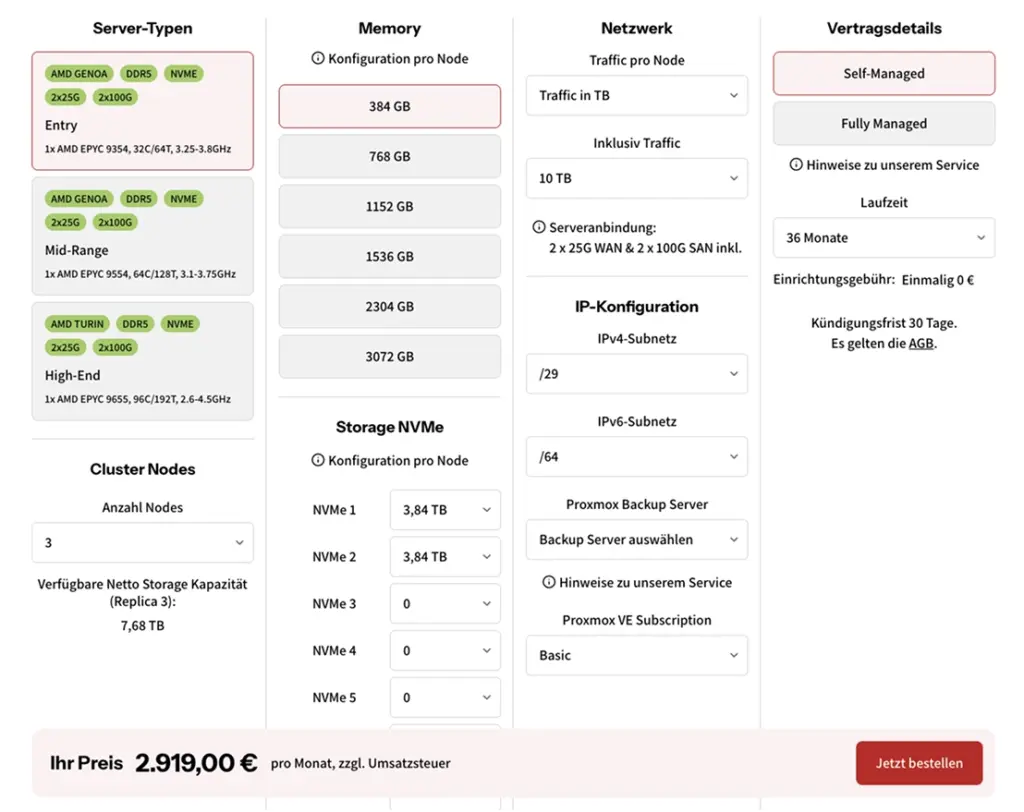
Configure your Proxmox cluster to meet your availability and performance requirements. Define nodes, storage, and infrastructure components, and design an architecture that is reliable and scalable.
Or schedule a personal consultation —we’ll help you plan your cluster architecture.
Reliable operation for complex cluster environments
A Proxmox cluster provides high availability—but it also requires clear operational procedures. partimus handles the ongoing maintenance of your environment and ensures that all components work together seamlessly and operate stably at all times.
Your cluster is continuously analyzed to detect anomalies early on. This allows potential problems to be addressed in a targeted manner before they affect operations.
Maintenance and updates are performed in a structured manner and tailored to your environment. Thanks to the cluster architecture, many tasks can be carried out without interruption.
If a malfunction occurs, it is analyzed in detail and resolved. The causes are clearly identified to prevent similar problems in the long term.
You’ll be working with contacts who are familiar with your cluster structure. This enables quick coordination and practical solutions without unnecessary detours.
The day-to-day operation of your cluster is clearly structured and professionally organized. You always know who is responsible for which tasks, allowing you to maintain control over your infrastructure without operational complexity.
Planning and Implementing a Proxmox Cluster
A cluster isn’t built from off-the-shelf components, but rather from the right combination of nodes, storage, and networking. Define your requirements and plan your infrastructure directly in the configurator —or work with our experts to finalize the details.

A Reliable Foundation for High-Availability Systems
A Proxmox cluster can only realize its full potential on an infrastructure that is consistently designed for reliability. The location, power supply, and security strategy play a key role in ensuring the stable operation of your systems.
The underlying data center infrastructure is designed for continuous operation. Redundant power supplies, network connections, and climate control ensure that your cluster remains stable even in the event of disruptions.
The environment meets recognized information security requirements, including those specified in ISO 27001. As a result, processes, access, and operations are implemented in a structured and traceable manner.
Their systems are operated exclusively in German data centers. This establishes a clear legal framework and ensures that your data is processed in compliance with the GDPR.
Your Proxmox cluster is powered by modern, energy-efficient technologies and electricity from sustainable sources. This allows you to combine high-performance infrastructure with responsible use of resources.
Access controls, surveillance systems, and segregated security areas ensure that only authorized individuals have access to the systems. Your infrastructure is protected both technically and physically.
When availability and stability are crucial
A Proxmox cluster is primarily used in situations where systems must be continuously available. Especially for business-critical applications, the cluster architecture ensures the necessary stability and reliability.
Systems such as ERP, CRM, or central databases are often essential for day-to-day operations. A cluster ensures that these applications continue to run even if individual components fail.
If you operate your own platforms or software solutions for customers, high availability is essential. Cluster structures ensure stable operation even when the load increases or technical issues arise.
Database services and backend processes benefit greatly from a stable infrastructure. By distributing the load across multiple nodes, performance remains consistent and outages are mitigated.
Companies with distributed structures need centralized systems that are accessible at all times. A cluster provides the foundation for reliable and consistent IT across multiple locations.
For service providers and MSPs, the stable operation of multiple customer environments is crucial. Clusters enable clear separation, high availability, and a scalable architecture.
A cluster really comes into its own wherever downtime is unacceptable. The infrastructure remains operational even during maintenance or in the event of malfunctions.
Get started with partimus
Take the opportunity to optimize your IT infrastructure and drive your business forward – contact us today to find out more about the tailored benefits partimus can offer you.
Everything You Need to Know About Proxmox Clusters
Would you like to learn more about Proxmox Clusters and how they are used? Here you’ll find answers to frequently asked questions. For specific inquiries, you can reach us at any time via our contact form, at [email protected], or by phone at 0049 6431 9452-0.
What is a Proxmox cluster?
A Proxmox cluster consists of several interconnected nodes that together form a virtualization environment. This allows workloads to be distributed and enables the system to compensate for the failure of individual nodes. The infrastructure remains stable even if individual components are unavailable.
When is a cluster a good idea?
A cluster is always worthwhile when high availability is required or downtime must be avoided. A cluster provides the necessary security and stability, especially for business-critical applications.
How many nodes does a Proxmox cluster require?
The number of nodes depends heavily on your requirements for availability, performance, and reliability. In practice, at least three nodes are often used to ensure a stable quorum and to reliably implement automatic failover. However, depending on the load profile and desired redundancy, a cluster can also be scaled up. We’ll help you define a sensible and cost-effective architecture.
What happens if a node in the cluster fails?
If a node within the cluster fails, the affected virtual machines are automatically moved to other available nodes. This process typically occurs without manual intervention and ensures that your applications remain accessible. This requires a properly designed cluster architecture with shared storage and properly configured failover. This significantly reduces the risk of downtime.
Can I expand my cluster later?
Yes, a Proxmox cluster is designed to be scalable from the ground up. Additional nodes can be integrated at any time without having to reconfigure existing systems. This allows your infrastructure to grow flexibly as your needs change—for example, as the number of users increases or new applications are introduced. The expansion is carried out in a structured manner and can be integrated into ongoing operations.
Can I configure my Proxmox cluster myself?
Yes, with the partimus Configurator, you can customize your Proxmox cluster and explore different architectural options. Among other things, you can define the number of nodes, resources, and basic infrastructure parameters. This gives you a clear picture of your future environment in advance. If needed, we can also assist you in evaluating and fine-tuning your configuration.
How much work does it take to run a cluster?
Operating a Proxmox cluster is generally more complex than operating a single-node Proxmox server, as multiple systems, network structures, and storage components must work together. Issues such as monitoring, failover, updates, and capacity planning require a structured approach and the appropriate expertise. At the same time, a cluster offers significantly greater stability and flexibility during ongoing operations. With professional management by partimus, the effort required on your part remains manageable, while your infrastructure is operated reliably and under controlled conditions.